Who Maintains the Grass? The New-Build Charges That Outlast Completion Day
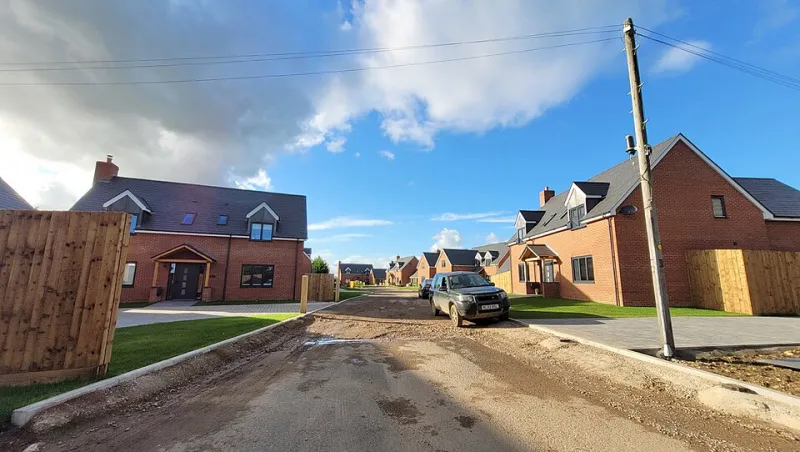
Photo: Jonathan Billinger , CC BY-SA 2.0, via Wikimedia Commons
You have picked the house. The kitchen has the island, the garden faces the right way, and the sales adviser has just handed over a brochure with a rather nice map on it. Somewhere in that pack, behind the floor plans and the specification sheet, sits a document that will cost you money every year until you sell — and most buyers skim it in the car park.
Freehold does not mean what your dad thinks it means
For a generation, buying freehold meant owning the bricks, the plot and the responsibility. Nobody sent you a bill for the grass verge. Then came the era of the managed estate, where the roads, the play area, the attenuation pond and the landscaping around the edges sit with a private company rather than the council.
This is where the word fleecehold crept into the vocabulary — a freehold house with leasehold-style bills. In 2026 it is still one of the most common surprises in the new-build market, and it is entirely legal provided the paperwork says so. The house is yours. The green in front of it is somebody else's business.
A service charge and an estate charge are not siblings
A service charge usually applies to a flat or a leasehold house and covers the building you actually live in — the roof, the communal hallway, the lift. An estate management charge, sometimes dressed up as an estate rentcharge, applies to the wider development. It pays for the things nobody thinks about until they stop happening:
- Grass cutting and hedges on communal land
- Maintenance of play equipment and seating
- The balancing pond and drainage system, at least until adoption
- Street lighting on private roads
- Insurance on shared open spaces
Some estates also carry a separate rentcharge, which is an annual sum payable under the Transfer deed. Historically that came with a fairly bracing remedy attached: if it went unpaid, the rentcharge owner could, in theory, take possession of the house. The Leasehold and Freehold Reform Act 2024 set out to change that, and the direction of travel is firmly towards transparency, but the practical reality is that buyers still need to read the deed rather than assume the law has done the reading for them.
The paperwork to ask for before you exchange
Nobody at the sales desk will be offended if you ask. If anything, it separates you from the people who do not.
The draft Transfer deed. This is the document that binds the house to the estate and names both the management company and the charge. Ask to see it, not just to hear about it.
The management scheme and budget. Ideally a projected annual budget for the first two or three years, broken down into what the money actually pays for. A single figure with no workings behind it is not a budget.
The developer's covenant. What have they promised to maintain, and for how long? Once the last house is sold the developer walks away — who picks up the tab then?
Adoption status. Ask which roads, drains and open spaces have been, or will be, adopted by the local authority. If the answer is none of them, expect the management company to be permanent rather than temporary.
The management company's accounts, if the estate is already running. A company with a healthy reserve is one thing. A company with a deficit and a list of unfinished jobs is another.
Written confirmation of the actual annual charge for this plot, plus any planned increases. It is about two hundred pounds a year means nothing if the real figure is closer to five hundred and climbing.
The bit about the play area nobody mentions
Communal features are lovely in a brochure. In practice they are the most expensive line items on the estate budget and the ones most likely to cause friction. A play area built to a high specification in 2020 can be a liability by 2030, and the reserve fund is what pays for the replacement. Ask how the reserve is funded and whether the equipment has been surveyed recently.
Drainage is the other quiet one. Sustainable drainage systems on new estates often sit with a private company until adoption, and unadopted SuDS can be a genuine headache for every household on the road. It is not glamorous, but it is exactly the sort of thing that ends up in a solicitor's letter five years later.
Questions worth asking in the sales suite
- Who is the management company, and who owns it?
- Can the homeowners ever change it? Is there a residents' company with a vote, or a route to take over the running of the estate?
- What is the charge for this specific plot, not the average across the development?
- What has it risen by since the estate opened?
- How would I challenge a charge I think is unreasonable? In England, the First-tier Tribunal (Property Chamber) can rule on the reasonableness of estate management charges, but only if you know the route exists.
- What happens if I refuse to pay? There should be a clear answer, and the answer should not be that they take the house.
If you are buying with a mortgage, your lender's valuer may also flag these charges, so it pays to have the answers ready before the valuation comes back with awkward questions attached.
If you are already living with it
Plenty of readers will be on the other side of this. If you are paying an estate charge you were not expecting, start with the budget and the deed rather than the phone call. Request the accounts, check the reserve fund, and ask which items have actually been spent rather than earmarked. Join or form a residents' association — management companies respond very differently to a group than to an individual.
And if you are selling, expect the buyer's solicitor to ask for the same documents you should have asked for at reservation. Keep them in one folder. Your future self, and your buyer, will thank you.
The short version
Freehold is still a good thing. It just is not quite the same freehold your parents bought in 1985. Ask for the deed, ask for the budget, ask who cuts the grass, and do not let a show home's scatter cushions distract you from a document that will outlast the smell of new carpet.